Powered By Blogger

Saturday, February 07, 2009

The night we dined in Hell !!

A recent writeup I did about the IIMA:IIMB volleyball match. Enzaaai !!!!

- - - - - - - - - -

hero

n. pl. he·roes

In mythology and legend, a man, often of divine ancestry, who is endowed with great courage and strength, celebrated for his bold exploits, and favored by the gods.

Legend has it that whenever there is injustice in this world, the Divine powers descend down on our planet to set things right. Ladies and Gentlemen, this is one such legend. A story that parents all over would share with their children to instil courage and bravery in them. A story that would go on to inspire thousands everywhere in facing their sorrow filled pasts. This ladies and gentlemen, is the story of 11 warriors who fought for justice, for what was rightfully theirs, for Sangarsh.

Around a year ago the warriors from the Ahmedabad clan had conquered the battlegrounds of IIMB volleyball court. The scars of defeat ran deep within the warriors of Bangalore who had fought hard but lost the previous battle with A. Cavalry had now arrived in the form of new spikers (read Vibhu and Nitin) and the defence too was strengthened with the arrival of new inspired soldiers (read Raja, Behl and Harish) . The clan had trained hard this time around. They worked together; they moved together, they hunted together. A recent defeat at Kozikode was seen as a mere hiccup and a learning huddle to only jump higher, strike swifter.

The lines were drawn, the net was raised and it was time for the refree’s conch to be blown. Sangarsh – The War of the IIMs was now dependant on this battle. The warriors from Bangalore had vouched not to return home without victory. Their strategy was simple. Do not let the ball touch the ground on our side. If the other side do the same, let them suffer hell in the process. Strike first. Strike hard.

The first point was a long rally with either side wanting to taste first blood. Yadav, the King Leonidas of our IIMB volleyball team had had enough. He sent a blow so hard, so deep within the opponents’ ranks that the fear showed in their quivering legs. From that moment on there was no looking back for the IIMB side. IIMB’s anchors, Sreejan, Harish, KC and Kuppili, held ground beautifully. They were the core reason behind every IIMB strike and every sore finger of IIMA. Every time the cannons were looped perfectly into the air by them and the IIMB spikers( Yadav, Vibhu, Rowdy and Manas) jumped to shoot, the IIMA players took 2 steps back. All they could manage was to just send the ball back only to face the barrage all over again. (The following was overheard that night in the IIMA night canteen – “Dude! I rather go to K and be held under house arrest than face this legen-wait for it-dary IIMB volleyball team. No Che??”). The IIMA tactics of just trying to place their attack never really troubled the IIMB team. The war was so swiftly won that it made Blitzkrieg look like stealing kandy (no pun) from a child. While the IIMB heroes were hailed as legends and carried on shoulders at one end, the IIMA crowd decided to maintain a minute’s silence to mourn their warriors at the other.

Dear Readers. The author is at this point so overwhelmed with emotion that he is unable to write further. So, he would like to end with this little phrase: “We won easily”

Thank you for your patience

Your friendly neighbourhood reporter

Dilip R.S. aka Rowdy

Friday, January 30, 2009

The light of knowledge !!

Observe the three logos below


All logos have the sun/sun rays in them :

The 3 institutes of education in my life

Monday, October 20, 2008

The man. The machine.Street Hawk

One of my all time favourties


Memories ARE made up of this....

Friday, August 22, 2008

Sports journalism at its best

Below is the article from http://football.guardian.co.uk
It is one the best I've read in some time. It is so moving and well written. It talks about the life of.. rather the reason for the life of the Croatian football player -Darijo Srna
Kudos to Jonathan Wilson.

Super Darijo a very proud son of the father

The remarkable life led by his father means the most astonishing thing about Shakhtar Donetsk skipper Darijo Srna is that he exists at all

Jonathan Wilson

August 21, 2008 1:57 PM

For his country Darijo Srna is a midfielder. For his club he is a full-back. At heart, he probably still wants to be the wing-back he was when he started his career. Tactically, the decline of 3-5-2 could have left him behind, but he has reinvented himself to become captain of Shakhtar Donetsk. Against Dinamo Zagreb in the Champions League last week, he was an obvious man of the match, whipping in a free-kick after three minutes to set them on the way to a comfortable 2-0 victory.

Niko Kranjčar, admittedly his room-mate on international trips, calls Srna the most under-rated player in Europe. And yet the most improbable thing about him is that he exists at all. The series of events that go to make any life can appear dauntingly improbable in retrospect, but Srna's career would have to take some truly extraordinary turns before his life-story became half as remarkable as that of his father.

Uzeir Srna was born in Gornji Stopići, a village near Čajniče in eastern Bosnia, a year before the Second World War. As the German advance met fierce resistance, the front line swept back and forth over the village, repeatedly forcing its inhabitants to flee. In 1941, though, with the fighting seemingly done, they returned home. It proved a ghastly miscalculation.

One night, the Chetniks, the Serb nationalist paramilitaries who waged their own war within a war, raided the village and burned it to the ground. Uzeir was grabbed by his father, and they fled into the forest with his teenage brother, Safet. His mother wasn't so quick. "She was pregnant," said Uzeir. "And she and my sister were burned alive."

Uzeir, Safet and their father fled north to Bosanski Samac, but amid the chaos of refugees Uzeir became separated from his father and brother. Somehow he ended up in Sarajevo, and was taken from there to Slovenia, where he spent a few months in an orphanage before being adopted by a police officer in Murska Sobota: the boy who had been Uzeir Srna became Mirko Kelenc.

Back in Bosanski Samac, further tragedy was to strike. "It was a stupid accident," Uzeir said. "My father had found a job in a small café. One day he was sitting outside it, and he got hit by a stray bullet that killed him." Uzeir has never found the graves of either his mother or his father.

In despair, Safet joined the army, but he never forgot his brother. Everywhere he went, he asked if anybody had seen Uzeir. Two years went by without any firm leads, but then he was posted to Niš in Serbia. His commanding officer there was a Slovenian, who remembered hearing about a Bosnian orphan who had been taken in by a family in Murska Sobota.

As soon as he could, Safet went to Slovenia to continue his search. It took him a few weeks to locate the Kelenc house, but when he did, he knew he had found his brother. The Kelencs argued that Uzeir would have a better life with them in Slovenia, but Safet was insistent, and took Uzeir back to Bosanski Samac, where he enrolled in the local school.

Even in the austere world of northern Bosnia in the years immediately following the war, the Srnas were noticeably poor. "I was always hungry," he remembers. "I saw my friends from school eating fresh bread and rolls, and it annoyed me, so I decided to become a baker."

Uzeir learned the trade, but barely had he begun to work properly when relatives from Sarajevo got in touch and asked him to go and live with them in Sarajevo. Delighted by the thought of a family, Uzeir agreed. "When I got my first salary in Bosanski Samac, I bought shoes, a jacket, a suitcase and a train ticket to Sarajevo," he said. "But I didn't know where they lived. So I walked round Sarajevo for hours before I found their house."

He struggled to find work as a baker, so Uzeir took on a series of manual jobs before finally, after several months, being offered a post in a bakery. It was there that he began to play football fairly seriously, being taken on as a goalkeeper by FK Sarajevo. Wandering, though, was in his soul. He met a group of Serbian engineers who asked him to go to Belgrade with them, work for their company and play for their local club. He followed them, but didn't settle there and returned to Bosnia, following his brother into the army.

He was posted to Busovača, a small town in central Bosnia. "There I started to play for Jedinstvo, the local club," said Uzeir. "I remember we had a friendly match against Čelik from Zenica. They were a big club at the time. A few days after the game, some people from Čelik asked me to go and play for them, but it was never meant to be for me in Zenica. They had a good team and decided to send me out on loan."

Before that could happen, though, Uzeir travelled to Croatia with Čelik for a friendly against Neretva in Metković. "Just before the game, Neretva's goalkeeper was injured," Uzeir said. "So they asked me because I was Čelik's reserve to play for them. After the match, they ask me to stay, because they were pretty impressed with my goalkeeping."

There Uzeir married a local woman called Nada, and they had a son, Renato, who is now a coach at Neretva. The marriage broke up, though, and he went to France, playing and working in Paris for four years before returning to Metković, where he met and married another woman, Milka, with whom he had two children, Igor and Darijo. He worked for a time as a truck-driver, before Neretva asked him to coach their youth side. One of his charges was Darijo.

"Even though he was really small, a lot smaller than the other kids, everybody knew Darijo was a great talent," he said. "He was good at handball, table tennis and basketball. One day he even came home from school and said that his teacher had told him to quit football and focus on basketball."

Fortunately he ignored him. "When he was a kid, he had offers from Dinamo Zagreb, Zagreb and Varteks Varaždin," Uzeir said. "I knew that Varteks had a best facility for young players, so I told him that best thing for him is to play there." But then the former Hajduk Split player Ivan Gudelj came to their house in Metković, offering a trial at Hajduk.

For the Srnas, that was a big risk. They are Bosniak, and as the war rumbled on, it was soon apparent how difficult it would be for a young Muslim player to be accepted in Split. "It was a difficult time," said Uzeir. "And your name was so important. But the worst thing was that the coaches came and openly demanded money for Darijo to stay there. Luckily he was so talented that when the youth coaches saw him, they decided he had to stay."

He stayed until 2003, when he moved to Shakhtar in a transfer so lucrative that Uzeir could comfortably buy a bakery of his own. Darijo has bought him a Mercedes and a BMW, but Uzeir still lives in his small apartment in Metković. "I always tell Darijo that you have to save your money when you're earning it," Uzeir said. "There's nothing to save when you're broke. The only difference to when he first moved in with Milka is that there is now an Astroturf pitch just around the corner, Darijo's gift to his home town.

"My father and my family mean everything to me," Darijo has said. On his calf he has a tattoo of a deer ('srna' in Croatian), while on his chest he has the name of his brother, who has Down's syndrome. Every goal he scores he dedicates to Igor. "I can't forget how they suffered while they were trying to find money for me during my days at Hajduk," he said.

"I can't forget that. My father had a really, really difficult life and I am very proud he can live peacefully now, without stress. I know it's impossible to repay him for everything he has done for me. But, I have bought him a car and given him enough money to live normally now, while he is old. It's the least I can do."

Beside his father's life, adapting his game to play a little deeper doesn't seem much of a strain.

Monday, August 11, 2008

Such is life

I have heard of many descriptions of life, many analogies being drawn upon to explain it being twisted and complicated but this takes the cake

"The trouble with my life is that it's like a bra strap when you put your bra on wrong. So there's one part of the strap that's all twisted and sticking out under your T-shirt and you fix that, and then the part near the hook becomes tangled. Then, after you've struggled with it for a while, because you can't see so far down your back, and straightened it out, the bit near your boob is all funny. So if I've got my career sorted, my love life magically vanishes without so much as a goodbye. Then I've got my love life all perfect and I'm seeing us making fat, happy babies, and boom! my family is fighting, and so on. You get the picture."

-Meenakshi Reddy Madhavan, avid blogger ( http://thecompulsiveconfessor.blogspot.com/) and author of "You Are Here"

Sunday, August 10, 2008

and on this day...

On this day but years ago....

480BC: A Sparta/Greece dream army are defeated by the Persians at the Battle of Thermopylae. If only they'd worn coats...

1936: In one of the few amusing moments of the Nazi regime, Jesse Owens picks a hole or two in that Aryan wheeze by winning his fourth gold medal (in the 4x100 relay) of the Berlin Olympics. Like the sulky bastard he was, Hitler does one rather than shake hands with the winners.

1945: The second atomic bomb is dropped on Nagasaki by the Americans, finally persuading Emperor Hirohito to admit defeat.

1969: The bodies of five people - including Sharon Tate, pregnant wife of Roman Polanski - are discovered at a house in Los Angeles, having been butchered by Charles Manson's Family. Amusingly, Manson was turned down for parole for the eleventh time in 2007.

Courtesy : http://football365.com

Friday, August 08, 2008

The chosen pong

Wonder what the Oracle had to say about this


Courtesy : http://xkcd.com

Wednesday, August 06, 2008

made in USA

US ECONOMY -
Dr. Marc Faber concluded his monthly bulletin (June 2008 with the following:

" 'The federal government is sending each of us a $600 rebate. If we
spend that money at Wal-Mart, the money goes to China. If we spend it on
gasoline it goes to the Arabs. If we buy a computer it will go to India.
If we purchase fruit and vegetables it will go to Mexico, Honduras and
Guatemala. If we purchase a good car it will go to Germany. If we
purchase useless crap it will go to Taiwan and none of it will help the
American economy. The only way to keep that money here at home is to
spend it on prostitutes and beer, since these are the only products
still produced in US. I've been doing my part."

Thursday, May 15, 2008

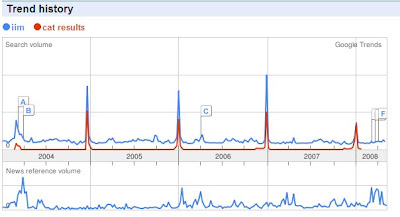
Causation or Correlation ????

Checked out google trends today. It can be added to the list of "Things to do to spend time in office" along with youtube, zapak and the likes

Q) What does it do?
It lets you in on volumes of any words searched in the past (last 3 years or so)

Q) How does i access it?
www.google.com/trends

Q) I still do not understand. please give me an example.
Eg: 1


Eg: 2


Eg: 3
Please note


See a pattern?

Courtsey : 2paiseworth.blogspot.com/

Thursday, May 01, 2008

Moto Racer

There were these four guys. They used to play "Moto Racer 4" regularly. The game had a 4 player option. All played on one keyboard.
Those were some of the best times of their lives.

Then came some more of them. They started playing Moto Racer 1 (Speed Bay track) .
They totally loved the "You've lossst the Raaacccee" at the end.
Those were more good times.

Sunday, April 06, 2008

twice lucky... third time?

"From confessions of Sabauddin, one of the prime accused in the IISc attack, police have learnt the IISc attack was 'premature' and failed to 'please' the LeT bosses. These revelations suggest that LeT's first major target in Bangalore was Le Meridien on Sankey Road, followed by PES Engineering College in BSK III Stage, IIM-Bangalore. IISc was last on the list."


Once bitten.... twice shy
Twice escape.... third time jai?

all is fair in war

The "just solution of the Kashmir issue should be in line with the wishes of the people of Kashmir and Pakistan," Foreign Minister Shah Mehmood Qureshi said


I won't say more.

Wednesday, March 26, 2008

Chronicles of the Monetarist

Short Story 1
Forgetful,Brilliant and rarely humorous Professor :
"I will tell you all a joke. (a sly grin flashes across face) Why was Adam the first ever accountant?"

(half the class wakes up to this challenge, looks around)

Professor continues :
"Because he was the first one ever to turn a leaf and make an entry"
(grin becomes more wider with guilt)

(3 guys roll with laughter. rest of class goes back to sleep)

Short Story 2

Student : What are the end term portions? Where do we study from? What can we expect?

Forgetful,Brilliant and rarely tactful Professor :

"As usual, carefully follow the class notes. Like Philip Weiss, a character in Vikram Seth’s novel The Golden Gate (“He drinks and he continues drinking/And having drunk, he drinks again”) for the exam “Do read and continue reading/ And having read, just read again."

(evil grin surely flashing across face)

Sunday, March 23, 2008

Manchester United 3-0 Liverpool

This is one of the best starts to a week that I could ask for.
Was tensed all week long about the ManU- Pool match.
Rafa had commented earlier in this week that United will be challenged for their title race ( motivational talks ? ). With Liverpool's recent winning run and with the champions league ahead it was all set for a tight match.

That's exactly how it turned out. A very cagey start. But an uncalled for second yellow (red) to gifted the game to United.


From a quick United counter and brisk movement, Rooney who had a superb game (but for the finishing) sent in a lovely cross from the left flank. Brown rose high up in the center ready to head it in with ease. But Brown being Brown he turned his back to the ball and it looked all set for a bad miss. But Reina being Liverpooldian (Bah !!!!....however it is spelled) decided to shoot himself in the foot and he made sure it was an own goal. Once that happened the game was all ours. Albeit late a goal each from Ronaldo and Nani sealed the game.
I never imagined I would ever put up a Wes Brown pic on my blog but nevertheless... Manchester United 3-0 Liverpool


Friday, March 21, 2008

H


Had the lots for our Hostel rooms last night. We got really lucky and so our new Homes for year 2 will be in H-mezz - my current floor

"H is where the Heart is
H is where Home is"

Wednesday, March 19, 2008

You know you are screwed when.... 1

You know you are screwed when ...............


............... your new phone's (N73.. :( ) display looks like this.

There goes another item to my long list of "dropped it...broke it" !!!!

Wednesday, March 12, 2008

THE game

The match started years ago
Both teams have had a very good first half.
With one team bringing the heat on late in the first half, it looked fully set for a thriller.
But then came the break...
HALF TIME !!!!

Tuesday, December 11, 2007

Down by Law

Are we heading towards a dystopian society???? A question I often tend to ponder upon.
Came across this very interesting article
"

Are we free to be foolish?

The state thinks citizens are incapable of making right decisions; the laws it makes betray that mindset
Shruti Rajagopalan

The original purpose of laws was to prevent humans from infringing on another individual’s rights and liberty while exercising their own. So, any infringement on another person’s life, liberty and property in the broad sense became punishable by law so that men can coexist. The examples are obvious; theft, assault, murder, rape, fraud etc. These laws are absolutely essential for a free society.

The second set of laws, far more controversial, is those criminalizing acts which have no victims. Human acts which offend society in general or tarnish the moral fabric that a community seeks to preserve are also punishable. These laws detail what are also known as victimless crimes as there is no specific infringement on another individual’s life, liberty or property. These laws outlaw prostitution, suicide, drugs etc. In an ideal world, these laws shouldn’t exist and an individual’s rights must be supreme, but then that is in an ideal world.
While there is clear reason and purpose for the first set of laws to preserve order and uphold individual rights, and one could find religious or moral justification for the second set, there is a third set of laws which exist just to satisfy the whim of a nanny state, or in our case a mai-baap state, to protect an individual from himself.
The paternalistic state believes that people are fundamentally stupid and must be protected from behaving rashly, even if such behaviour affects no one else. The most obvious example of this is the helmet law, or the requirement to wear seat belts, which seems innocuous. But what happens when the paternalism is taken to a new level? By outlawing street food because it is presumed to be unhygienic? Or, in an outrageous example, the nanny state excluding the individual from litigation to protect one from one’s lawyers?
So, the real question is: Do we really need the state to protect us from ourselves or our foolishness? Or are we capable of evaluating the little risks we take to make our lives more pleasurable?
The helmet law or the requirement to wear a seat belt is an excellent example. But it doesn’t stop there. The Indian government likes to believes in the English notion of parens patriae , where the Crown is the protector of his subjects as a parent.
For instance, the West Bengal government attempted to outlaw hand-pulled rickshaws, to preserve the dignity of the rickshawpuller and to give the presumption of a less disparate society. The rickshawpullers obviously oppose the law as they are happy pulling rickshaws and value their source of livelihood. But do they know better? Can they be trusted with preserving their own dignity? Was it not the actual father of the nation who said that all work is worship?
It’s not just rickshawpullers. Virtually all labour laws in India attempting to protect labour from the exploitative capitalist actually assume that every individual labourer is incapable of entering into a contract, being aware of the risks and rewards, and making a living. It takes away the right of two adults to enter into a mutually agreeable contract.
Similarly, the government outlawed bar girls from dancing in bars to preserve the dignity of these women. What they did has put many thousands of women out of work and taken away their only source of livelihood. Did the bar girls weigh their loss of dignity against their livelihood? Or perhaps they felt no indignity in dancing to entertain at bars in the first place!
The Supreme Court, as always, has taken paternalism to a new level when it banned cooking on the streets by street vendors because street food, by default, is always unhygienic and citizens are too stupid to choose what to eat. We are all aware of the potential risk of falling sick eating pani puris on the street and yet we value the pleasure of a good, and slightly unhygienic, pani puri over the expected risks. But can we really be trusted with such an important decision?
Most of these instances may seem trivial to those who are not part of informal labour force, or who don’t enjoy that occasional pani puri. But sometimes paternalism in India takes on Orwellian forms.
The Indian government took it to a whole new level during the Bhopal gas tragedy case more than 20 years ago. It passed the Bhopal Gas Tragedy Act, 1985, which allowed only the state to sue Union Carbide.
The victims and citizens of Bhopal were not allowed to sue the company who took away the lives and health of their families and the prosperity of their city because the state felt that “ambulance chasers” would take away most of their compensation in legal fees. While the ambulance chasers might have taken away most of it, the government did an even more efficient job by taking away the entire compensation of most victims.
While each instance seems trivial, especially since it affects particular classes of people, there is a larger question at hand. Do we have the right to take risks that only affect us? Do we have the freedom to live our lives as we choose after weighing the risks, even if we are being foolish according to the government? And if part of freedom is the freedom to be a fool, are we free?"

All credits to Mint and Shruthi Rajagopalan for this wonderful article

p.s. I have a very high emotional attachment to pani puris, especially the those made by the road side made gaadis.

Friday, October 26, 2007

Call Marx

Politics in Kerala plumbed shameful depths when a teacher in the most literate state of the country turned on a group of four primary school kids and thrashed them on the basis of a complaint from a local CPM boss who accused them of damaging the party's posters outside the school.

In what must set a new benchmark for reprehensible conduct, the four students — Ajin Dev, Akhil Dev, Anoy and Shobin, all students between ages seven and nine of government-run primary school in Kozhikode — were beaten up by their teacher on October 23, as a result of which the traumatised kids have refused to go to their school.

Following a complaint by their parents, the police have registered a case of threatening and hurting minors against CPM leader Yugesh Babu, who is also a member of the local gram panchayat, along with the headmaster and their woman class teacher.

The controversy assumed a bizarre political twist with rumours flying thick that the kids had to pay for the political beliefs of their parents, who, it is learnt, are sympathisers of another party. As a result of the rumours, the district education office has stepped in and an inquiry is being conducted by the assistant education officer.


This is where our country is going to. Such politicians and "teachers" should be made examples of and severely punished, should be made social outcasts. If a highly literate state like Kerala has such incidents involving educators where is the hope for the rest . And this is not the first time the communists in Kerala have taken to violence for not adhering to their ideologies.


Saturday, October 20, 2007

Dumb-eldore

If you thought having 2 tests and a really bad cold are bad enough to ruin your Saturday, then think again.
Read below :


"NEW YORK: Harry Potter fans, the rumors are true: Albus Dumbledore, master wizard and Headmaster of Hogwarts, is gay.

JK Rowling, author of the mega-selling fantasy series that ended last summer, outed the beloved character yesterday night while appearing before a full house at Carnegie Hall. After reading briefly from the final book, "Harry Potter and the Deathly Hallows," she took questions from audience members.

She was asked by one young fan whether Dumbledore finds "true love".

"Dumbledore is gay", the author responded to gasps and applause.

She then explained that Dumbledore was smitten with rival Gellert Grindelwald, whom he defeated long ago in a battle between good and bad wizards. "Falling in love can blind us to an extent," Rowling said of Dumbledore's feelings, adding that Dumbledore was "horribly, terribly let down."

Dumbledore's love, she observed, was his "great tragedy".

"Oh, my god," Rowling concluded with a laugh, "the fan fiction."

Potter readers on fan sites and elsewhere on the Internet have speculated on the sexuality of Dumbledore, noting that he has no close relationship with women and a mysterious, troubled past. And explicit scenes with Dumbledore already have appeared in fan fiction."

Even though I am a Harry Potter fan I find it really revolting to talk about the sexual orientations of age old wizards.
What next?
Penolope Pitstop is lesbian?????